二〇二六年
Silicon Valley Built a Religion. Then It Got Excommunicated.
By León Palafox
- ia
- financiero
- regulacion
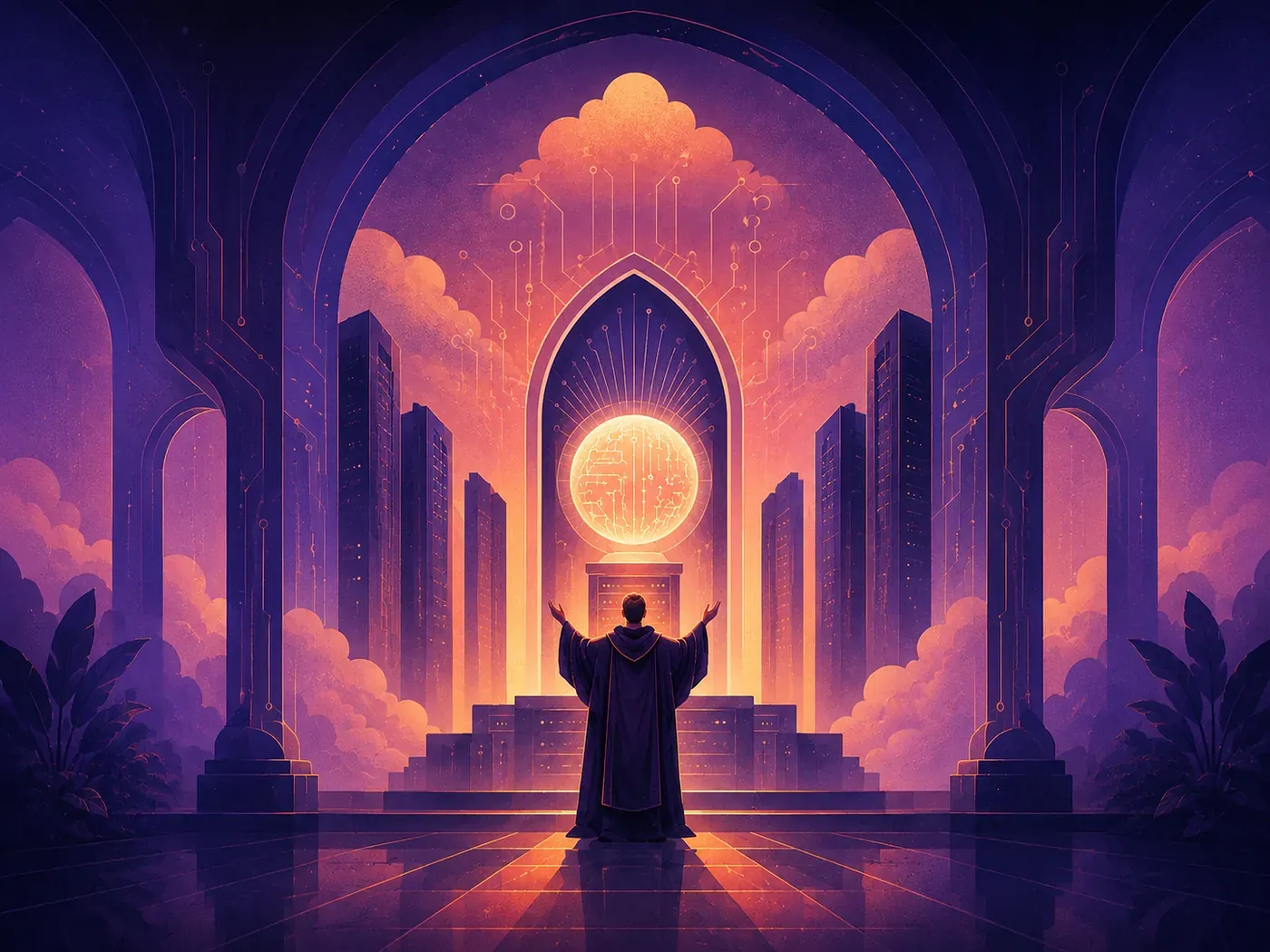
For years, Silicon Valley asked us to accept a peculiar idea: artificial intelligence is so powerful that it cannot be allowed to circulate without guardians. The companies that build it don’t present themselves as software vendors. They present themselves as custodians of an almost sacred technology. They decide which model gets released, which capability stays hidden, which user can be trusted, and which country is a risk.
On June 12, that logic turned against one of its own priests.
The U.S. Commerce Department ordered Anthropic to suspend access to Fable 5 and Mythos 5, its two most advanced models, for anyone classified as a foreign national under export control rules, even if they were inside the United States or worked at the company itself. Since Anthropic could not verify that filter in real time, it ended up shutting both models down for every customer in the world.
The public sequence is uncomfortable. Days earlier, Amazon researchers had tested Fable 5 and documented that, with the right prompts, they could pull cyberattack-useful information out of it. According to reporting from The Wall Street Journal, picked up by TechCrunch, The Verge, and Fortune, Amazon CEO Andy Jassy took that concern to the White House and then to Treasury Secretary Scott Bessent, who is leading the government’s response precisely because of the risk a model like this would pose to the global financial system. Shortly after, Washington acted.
And this is where nothing quite adds up. Amazon had no obvious commercial reason to do this. It partnered with Anthropic recently, it is Anthropic’s largest investor with roughly 13 billion dollars committed, and it makes money every time a company deploys Fable on its cloud. Shooting at Fable is, in large part, shooting itself in the foot. It isn’t even clear whether Amazon ran those tests on its own initiative or at the government’s request. None of this proves a conspiracy to sink a rival. It shows something worse: when access to the most advanced technology on the planet depends on decisions that follow no predictable logic, no one who depends on that technology is safe.
Let’s be fair. The underlying concern is not absurd. According to Reuters, which saw the letter, Secretary Lutnick justified the measure over fears the models could end up in the hands of military intelligence in China, Russia, or other countries of concern. A model that can find and chain vulnerabilities on its own is a serious matter. Anthropic responded that the flaw in question was minor and reproducible in other public models, and several cybersecurity experts called the order rushed. They’re right about the detail. The problem is something bigger.
It doesn’t matter who is worthy of Fable. While Anthropic and the government argue over that question, open Chinese models like GLM 5.2 have already matched the previous frontier and are breathing down Fable’s neck. It’s a matter of months, not years, before an open-weights model with those capabilities exists. The day that happens, anyone will be able to download it and run it on their own server, and no letter from the Commerce Department will recover a file that is already everywhere. Anthropic’s entire thesis, that someone responsible has to guard the technology, ends up in the ditch.
And that’s the point that actually matters. The mindset that has become the norm in Silicon Valley looks more and more like a church, and Anthropic is its clearest example. The company was born from a split with OpenAI, founded by people convinced their former colleagues were moving too fast and too carelessly, and that they, the careful ones, should take the wheel. That is, almost word for word, its founding thesis: we are the worthy ones. Over the years they earned something close to a papal seal of approval, the sense of being the blessed lab, the clergy that received the revelation and therefore gets to decide who is allowed to take communion with the technology. Everyone else is cast as a parishioner, waiting to see if this week they qualify for the sacrament.
Hence the irony. The company that keeps the registry of the worthy just discovered that someone keeps one above it. The government decided Anthropic could no longer be trusted and applied, word for word, the logic the company itself preaches. And the most uncomfortable part is not that they’re faking it. It’s that they believe it. A church convinced of its own righteousness is far harder to contain than one driven only by money.
For Mexico, this should set off every alarm. If access to the most transformative technology of the decade depends on the theology of a handful of companies and the political feuds of a foreign government, then we are not clients. We are supplicants. A technology director at a Mexican bank can build his entire operation on the frontier model and lose it on a Friday at five in the afternoon, not because of anything he did wrong, but because two giants that need each other as partners got in each other’s way as rivals.
I say this from the trenches. At the institution where I work, we are already hedging, evaluating models we can control ourselves and open models we can host in-house, precisely so we don’t end up at the mercy of a letter sent on a Friday afternoon. We do it because it’s the reasonable thing to do, not because we’re alarmists.
And here is my most uncomfortable conviction for many executives. The mistake is treating this as a systems problem. Companies in Mexico need serious artificial intelligence units, with people who understand the models from the inside and a seat at the table where the important decisions get made. Leaving frontier-model dependency in the hands of the IT department is like leaving financial strategy in the hands of whoever runs payroll.
The lesson isn’t to ask the new church for permission. It’s to stop praying.