二〇二六年
The Algorithm’s Brutal Honesty
By León Palafox
- ia
- financiero
- davos
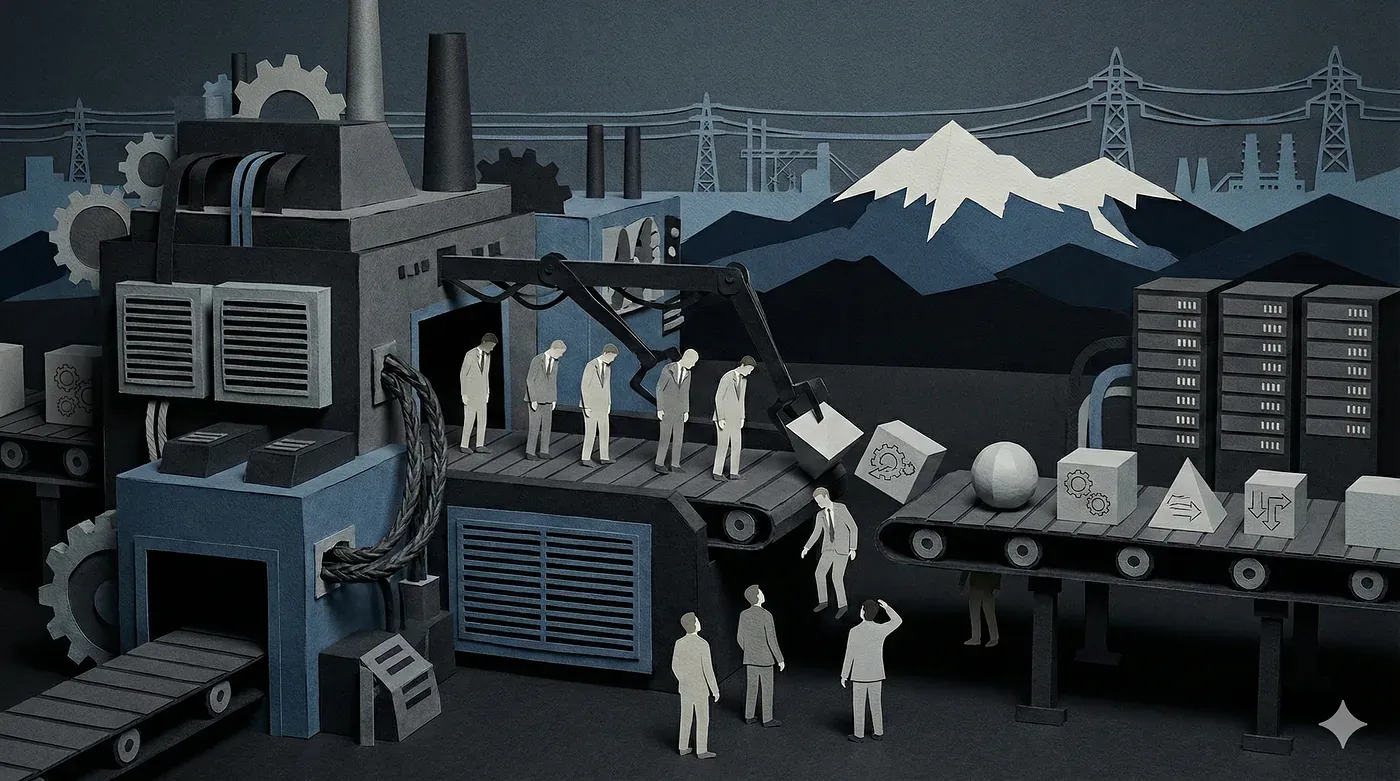
“The phase in which AI was an optional experiment is over,” Dario Amodei told a quiet room in Davos this week. “Today, entire companies depend on this technology delivering results beyond impressive demos.”
Everything about the World Economic Forum this year has made the tech industry look heavy, industrial, and uncharacteristically grim. The conference began with leaders shedding the “copilot” euphemisms of 2025 and ended with the Salesforce CEO speaking plainly about “processes that will no longer require human intervention.” For the new class of AI industrialists, nothing — not even the social contract — transcends the brutish transactionalism of the balance sheet.
Coolly assessing that transactionalism is what landed the tech sector in this new, harsh light. Two things stood out to me about the pivot that occurred at Davos this week. First, the conversation shifted from software to physics. Speakers used words like “infrastructure,” “cooling,” and “energy” obsessively. They spoke of the cloud not as a limitless dream, but as a heavy industry constrained by the power grid. This is what AI is now to us: Not the magic assistant we once knew, or thought we knew, but “the load.”
Second, the discourse abandoned the comfortable fiction of “augmentation.” For the last few years, the tech industry has relied on a specific narrative architecture. The slogan was “AI is a Copilot.” It allowed CEOs to say, “We are not replacing you; we are empowering you.” It allowed them to conceal the low foundations of automation — cost-cutting and labor disciplining — behind the facade of something high: human potential.
At Davos 2026, the industry stopped maintaining that facade.
What is striking about this new era of AI is how devoid it is of idealism of any kind. What the tech leaders left out of their 2025 narrative is that, to the markets, some efficiencies are stronger than others.
Here is what the “autonomous agent” is really saying to the workforce: “I, the algorithm, function cheaper than you. I behave in the manner expected of the P&L statement. I am obedient and do not require health care.”
This message, of course, has an addressee: It is directed above, to the shareholders. The AI industry is no longer embarrassed to put such an unequivocal statement of displacement in the shop window.
This current iteration of AI capitalism does not hide behind the pretense of “making the world a better place.” Part of its pitch is that it offers its disruption as a thuggish honesty: This is what the market demands. We are the only ones brave enough to build it. Investors believe that human labor is a liability. The AI sector proves them right by flaunting its ability to excise it; its success confirms their frustration with human friction and the need for a system that has mastered pure efficiency.
This is both a lie and a weakness. It is a lie because the “inevitability” of mass displacement is not a law of physics, but a choice of engineering and policy. And it is a weakness because it creates a hunger for its opposite.
There is a reason the warnings from Anthropic regarding the “pace of displacement” lit such a fire: They were, themselves, acting against the industry’s self-interest. They were admitting that the transition might break the people it was meant to serve. It was a bracing admission, but more than that, it was a necessary crack in the armor. It was the kind of doubt that the new triumphalism suggests does not exist.
I am not saying this will go well or easily for the workforce — or for the leaders who choose to prioritize stability over speed. The market is vengeful, and the engineers are right that automation can inflict terrible obsolescence on any sector it chooses.
But the critics are right that an economy is, in part, dependent on the willingness of its participants to be entwined with its progress. You cannot maintain a social compact based on mutual benefit when the technology is explicitly designed for your subordination.
The economy is built on relationships, not just leverage, and relationships are built on reciprocity and trust. It is not the AI industry’s genius to recognize the unused leverage of automation; it is its blindness to see that our social stability was a function of our restraint.