二〇二六年
The SpaceX IPO Is Not Just a Space Story
By León Palafox
- ia
- financiero
- espacio
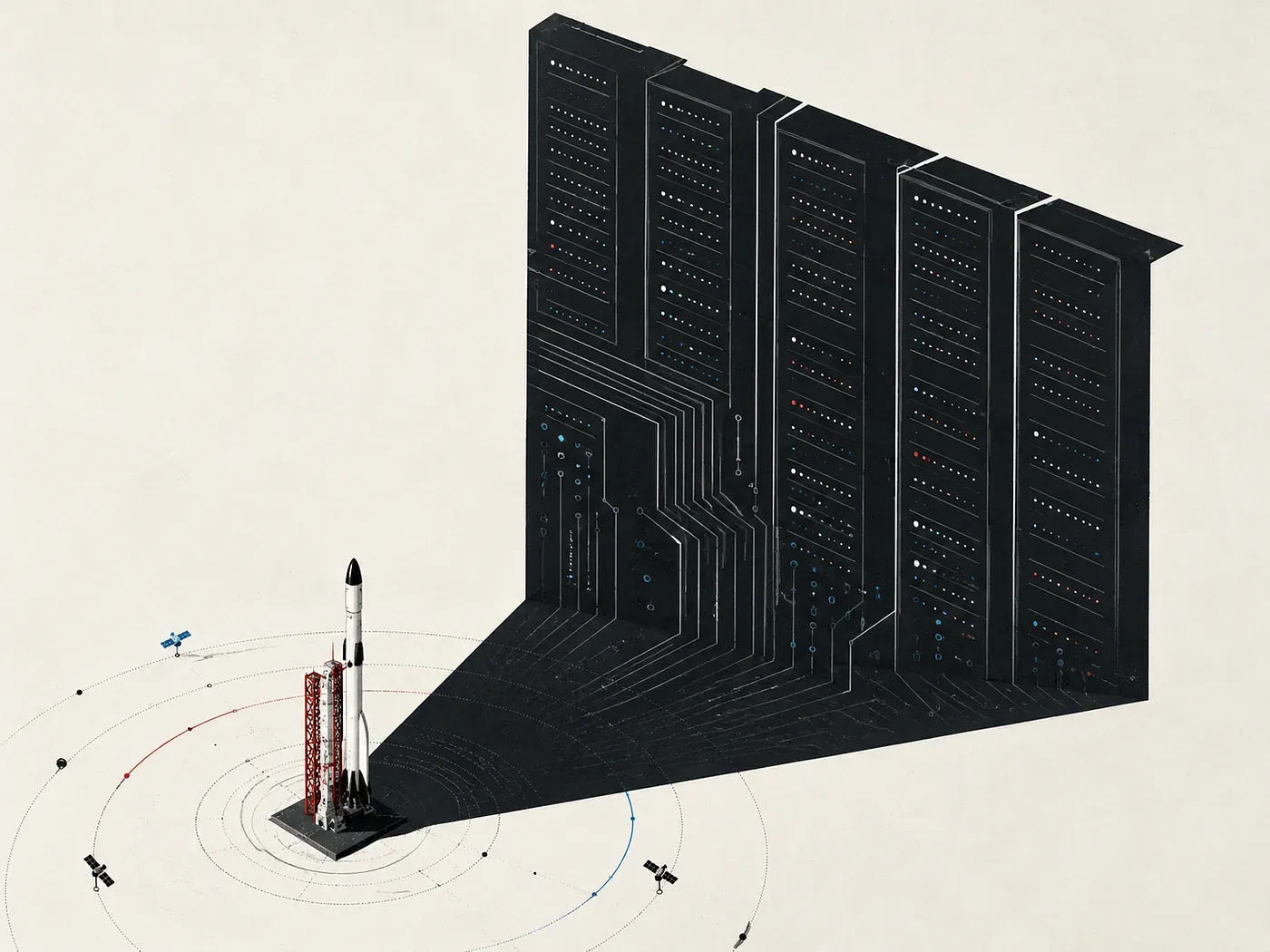
SpaceX filed its S-1 on May 20. When it starts trading on Nasdaq on June 12, the market will frame it as the great IPO of the space industry. But the prospectus tells a different story.
SpaceX is coming to market as a bundle of three businesses: Starlink, launches, and xAI. The problem is that the business most important to the valuation may not be space. It may be artificial intelligence.
The numbers are uncomfortable. xAI, absorbed by SpaceX in February, lost $2.5 billion in a single quarter. The launch business lost $619 million. Starlink, by contrast, was profitable and generated 69 percent of SpaceX’s $18.67 billion in consolidated 2025 revenue.
In other words, the AI bet is not being funded by AI revenue. It is being funded by satellite internet.
The discussed valuation, somewhere between $1.75 trillion and $2 trillion, only works if investors accept a very aggressive thesis: that inference costs will keep falling, that AI will become a platform shift comparable to cloud or mobile, and that the final market is not software but human knowledge work itself.
Maybe. But there are three major risks.
First, the model layer is becoming commoditized. DeepSeek, Qwen, and other open models are putting pressure on prices and weakening the advantage of frontier labs.
Second, the economic life of GPUs may be shorter than the accounting life used to justify the spending. NVIDIA’s cycle moves too fast.
Third, demand has not caught up with capex. Enterprise adoption is growing, but not at the pace implied by these valuations.
That is why SpaceX matters beyond SpaceX. It offers one of the first public windows into the real economics of the AI boom: massive spending, insufficient revenue, and a heavy dependence on profitable businesses subsidizing speculative bets.
OpenAI will be the next test. Its IPO will show the pure-play version of the same problem: whether frontier AI can turn massive infrastructure into enough revenue before models get cheaper and hardware ages.
The key signal will not be a bad quarter from an AI lab. It will be the first major data center or GPU writedown by a hyperscaler.
That is when we will know whether this was a revolution with patient capital behind it, or simply the most expensive capex cycle in recent tech history.