二〇二六年
The (AI) world just changed overnight.
By León Palafox
- ia
- financiero
- geopolitica
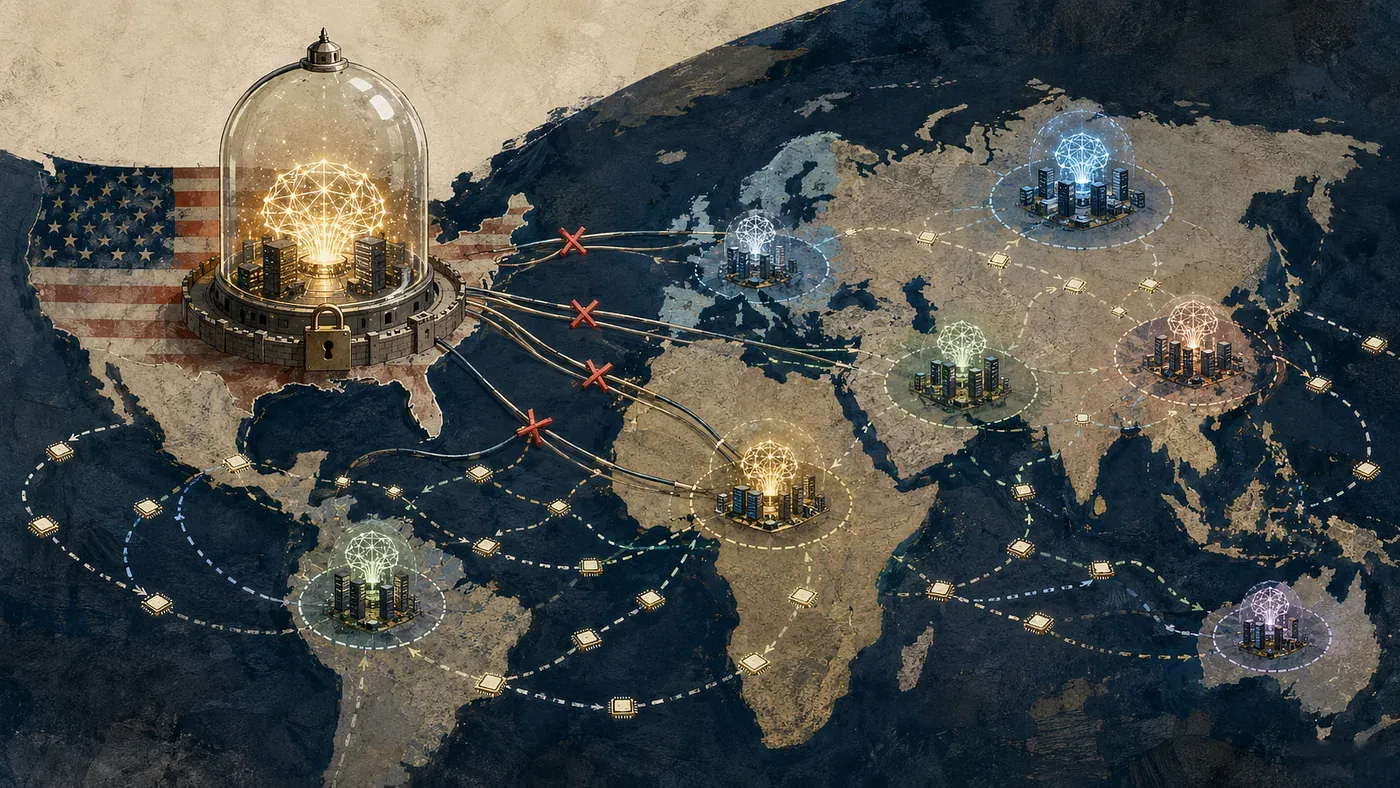
Today marks the start of a new era, and countries need to start understanding that a new world order is in place. On Friday, the Trump administration barred Anthropic from giving foreign nationals access to its two most advanced models — Mythos 5 and its guardrailed public sibling, Fable 5 — through a Commerce Department export-control directive. Because the restriction was nearly impossible to enforce cleanly — it covers not just people abroad but every foreign national inside the U.S., including Anthropic’s own non-citizen employees — the company shut down access to both models for all of its users.
Let’s be clear about this: for the first time in the AI boom, a nation is restricting the use of a product to a very specific set of users — effectively barring the rest of the world from the most capable technology and everything it enables.
I’ll divide this piece into two parts. The first is the working thesis that I and other analysts have been developing about Chinese models. The second is the case for nations hosting their own models inside their own borders, the same way every nation maintains a military.
For the longest time, many industry analysts have questioned the point of open Chinese models. Given the deployment speed of top U.S. labs like Anthropic and OpenAI, Chinese companies have looked like they are always five steps behind. So what’s the point of a product that is essentially identical but inferior?
The thesis has been that the Chinese don’t care about having the best model — they care about flooding the market with good-enough ones. For many tasks — basic coding, writing email, calling APIs — you don’t need Fable or any other frontier model. You need a competent baseline model, and that is exactly what the Chinese are perfectly capable of delivering. And let’s be clear: these are precisely the use cases that Anthropic and OpenAI are betting their enterprise push on — getting SaaS companies to embed their models across the suite.
Flooding the market with cheap models is a strategy we are already seeing take effect (WSJ). And Friday’s directive likely just accelerated that adoption. Why? Because many employees at U.S. companies are themselves foreign nationals on green cards or work visas. Andrej Karpathy — one of the most prominent AI researchers alive, who reportedly joined Anthropic in 2026 — is Slovak-Canadian, which means that under the plain text of this directive he may not have access to Mythos, even though it is built by his own employer. The move is dangerously shortsighted: it pushes companies harder toward open models for exactly the commodity workloads the U.S. labs were counting on to anchor their enterprise revenue — eating into the margins of the very giants the directive claims to protect.
Second, Friday’s order showed every country that depending on two American companies for its AI needs is a serious operational and sovereignty risk. Who’s to say Trump won’t ban less powerful models tomorrow in the name of national security? If that happened, the U.S. would hold a drastic operational advantage over the rest of the world — one that would be very hard to surmount. And yes, I do think individual countries should have their own models the same way they have weapons and an army. Regional efforts are laudable and commendable, but they raise hard questions: who gets access, and where is the model hosted? Who’s to say the host country won’t eventually adopt the same posture the U.S. just did?
So even though I believe in a Latin America of cooperation, I would never let Brazil or Argentina host a regional model that the livelihoods of Mexican or Bolivian companies depend on.
Friday’s order just changed the world order. We need to start reckoning with the consequences — quickly.