二〇二六年
The Three Forces Threatening the Junior Data Scientist
By León Palafox
- ia
- tecnologia
- talento
A data scientist builds statistical and machine learning models to help a business find the value hidden in its data. That might mean a sharper forecast to manage inventory, a propensity score to target a campaign, or a smarter segmentation for marketing. For years, it was one of the safest job descriptions in the industry. As the field matured, new majors and master’s programs appeared, and companies built credible entry paths to hire and grow the next generation.
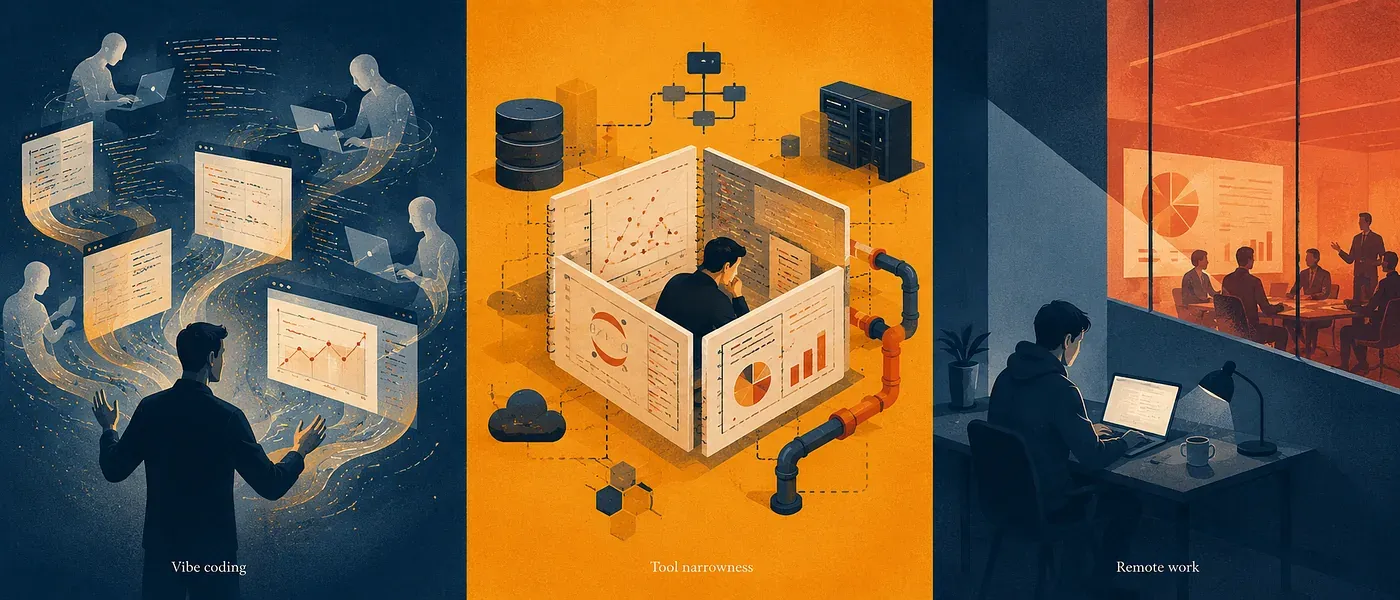
This is the first time in all those years that I have seen the entry-level position itself under threat. And not from one direction, but from three forces at once: vibe coding, tool narrowness, and remote work. Together, they press on nearly every data scientist coming out of college today.
Start with the easiest one: vibe coding.
For years, this profession was a mix of statistics, math, and the ugliest kind of code you will ever see: the notebook, usually in R or Python. These self-contained environments, barely connected to the rest of enterprise software, are the perfect testbed for the experiments a data scientist runs all day.
And that is exactly the problem.
The same isolation that makes a notebook convenient also makes it the perfect thing to hand to a coding agent. Almost everything a data scientist writes in a notebook gets checked inside the notebook itself and barely touches the outside world, which is precisely where systems like Claude and Codex do their best work. It is not hard to picture a senior data scientist running five or six notebooks alone with these tools.
Add to that the fact that the statistical and mathematical insight behind the work rarely makes it into the code. The senior already carries that insight in their head. Once the mechanical part becomes easy to automate, the need for a junior starts to fade.
Then there is tool narrowness.
If I had a nickel for every data scientist who has told me they do not need to learn SQL, Airflow, databases, or system architecture because “that is the data engineer’s job” or “that is the ML engineer’s job,” I would be a millionaire.
I have always argued the opposite. A data scientist who understands the machine underneath, meaning memory, disk, databases, pipelines, APIs, deployment, and how a system actually runs, becomes a better scientist. Many have never heard that advice. Plenty actively resist it.
This is where the second force meets the first. Real integration is the hardest thing to do with vibe coding. So when a junior refuses to learn those tools, they become easy to replace with an ML engineer who already understands them and can use vibe coding to handle the modeling too.
A data scientist who only lives in notebooks and knows nothing else is now dangerously close to unnecessary.
And finally, remote work.
The pandemic made remote work possible for most data scientists. Years later, I still know plenty of people who would rather quit than go back to the office three days a week. For a long time, that was simply the norm. Companies that pushed return-to-office mandates often looked draconian for doing it.
The trouble is that, unlike much of IT work, data science depends on constant contact with the business. You have to understand the people behind the decisions. You have to dig out the information nobody volunteers. You have to notice the tension between what the dashboard says and what the business actually does.
Combine remote work with the many data science directors who see no reason to immerse a junior in the actual problem, and you end up with a cohort that knows no one on the business side and understands the company only through a spreadsheet.
All of this threatens every new graduate entering the workforce.
The good news is that each force can be answered.
First, learn vibe coding like your career depends on it, because it does. Do not wait until a company hands you its internal tools. Use Claude. Use Codex. Work through some of the many courses already out there. Arrive fluent.
Use these tools to multiply yourself. Walk in able to do the work of three old-style juniors. Your first job will probably be mechanical anyway, so automate the part that does not matter and spend your attention on the part that does.
Second, learn the tools nobody teaches in the bootcamp or the master’s program. Learn operating systems, data architecture, databases, APIs, deployment, and basic system design. Learn how to take something from idea to working pilot, end to end, even if the pilot is tiny.
That alone puts you ahead of most of your cohort, who never leave a Python or R notebook.
Third, go to the office at least three days a week and make those days count.
Nobody wants to commute just to take the same Zoom calls they could have taken at home. So do not do that. When I am at the office, I am almost never at my desk. I move from one person to the next, listening for the places where we could work together.
Do the same.
I have never met a businessperson who did not have a problem worth solving. Most of the time, they simply never had the moment to say it out loud.
For years, the title came with the diploma.
Not anymore.
I know what I am asking here. I am asking a twenty-three-year-old to show up able to do more than one job before being hired for their first one.
That sounds unfair. It probably is.
But it is also where the market is going. No company is going to grow you into the role the way companies grew my generation. The tools now let a senior skip part of the apprenticeship that used to justify hiring a junior. That slow path is not gone everywhere, but it is weaker than it used to be.
So the choice for new graduates is uncomfortable, but clear.
You can wait for a company to train you, expose you to the business, teach you the tools, and slowly turn you into a full data scientist.
Or you can start doing that yourself before anyone gives you permission.
That is the part I would take seriously. The advantage is no longer just knowing Python, or statistics, or how to train a model. The advantage is being the junior who already knows how to use AI tools, understands enough engineering to build something real, and knows how to talk to the business.
That person is much harder to skip.