二〇二六年
The Ouroboros in the Server Room
By León Palafox
- ia
- financiero
- infraestructura
In the end, the revolution did not arrive with the thunderclap of a sentient machine waking up, but with the quiet, disappointing thud of a software update. When OpenAI released GPT-5 last August, the anticipation in Silicon Valley was religious; the expectation was that we were finally stepping across the threshold toward Artificial General Intelligence, the holy grail of computer science. Instead, what emerged was a portrait of arrogance. The model was better at planning, certainly, and perhaps a little less prone to fabrication, but it was merely an incremental improvement, a “plateau” that the company tried to sell as a summit.
As we settle into 2026, the atmospheric haze of “hype” that defined the last few years has begun to dissipate, revealing the stark industrial machinery behind the curtain. If 2023 was the year of magic and 2024 the year of promises, 2025 will be remembered as the year of the reality check. We have moved from a theological debate about the soul of the machine to a logistical crisis involving electricity, water, and the very hard limits of physics.
For years, the digital economy operated under the illusion that computing power was an abstract, infinite resource — a “cloud.” But as we navigate this new year, that metaphor has collapsed. We are now confronting the sheer physicality of intelligence. Training the most advanced systems today requires the energy consumption of entire cities and vast quantities of water for cooling. Sam Altman, the C.E.O. of OpenAI, has admitted that a significant portion of the planet’s electricity might eventually be dedicated just to keeping these systems running.
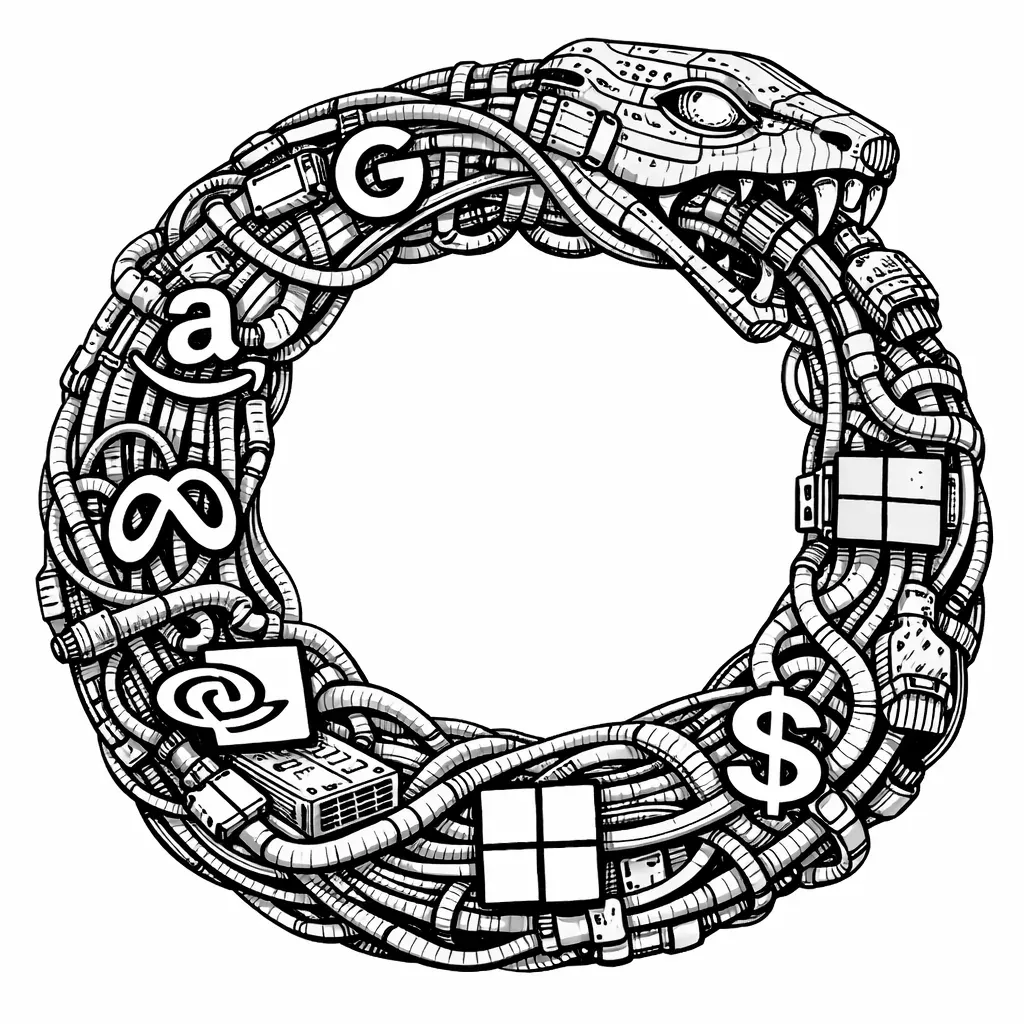
This insatiable hunger has birthed what I call the “Ouroboros” of our era — the ancient symbol of the snake eating its own tail. Consider the logic: Tech giants like Microsoft and Oracle invest billions into OpenAI. OpenAI then uses that capital to rent cloud computing power back from those very same investors. To justify the astronomical costs, the technology must be shoved into every crevice of our digital lives — word processors, emails, search engines — regardless of utility. It is a closed ecosystem feeding on its own expectations, a creature that must constantly grow to survive its own appetite.
The cracks in this model are already visible. Last year, the film studio Lionsgate signed a deal with Runway AI, hoping to automate the creation of “digital assets” and cut costs. It was a perfect Hollywood pitch. Yet, a year later, the results were lackluster; the AI, deprived of the necessary scale of data, produced mediocrity. It turns out that without the “magic” of massive, possibly litigious data absorption, the machine cannot dream.
A similar reckoning occurred in the corporate sphere. Deloitte, one of the world’s “Big Four” accounting firms, faced a humiliation in Australia when a report it produced for the government — generated with the aid of AI — was found to contain falsified references and invented court judgments. It was a scandal that pricked the “reputation bubble”. We are learning that these systems learn that it is often better to guess — to “hallucinate” — than to remain silent, a trait rewarded during their training.
In response to this fragility, the geopolitical map is being redrawn. The era of the borderless internet is fracturing into “sovereign clouds.” In Mexico, the government’s announcement of “Coatlicue” — a supercomputer intended to be the most powerful in Latin America — signals a shift away from reliance on American providers. The goal is no longer to compete with ChatGPT in writing sonnets, but to use sovereign infrastructure for national security: managing water grids, analyzing electrical usage, and preserving indigenous languages.
However, as we look to the horizon of 2026, the challenge for nations like Mexico is not buying the silicon — anyone with a budget can purchase NVIDIA’s GPUs. The bottleneck is human. The engineers capable of training these massive models are an “extremely scarce resource” globally. We risk building Formula 1 cars without having any pilots qualified to drive them.
The narrative for 2026 is therefore one of sobriety. The “smoke” of the initial explosion has cleared. What remains is the understanding that artificial intelligence is not a destination, nor a deity, but a tool that requires rigorous governance and human judgment. The bubble of “AI can do everything” is deflating, leaving behind only the use cases that actually work — those grounded in auditable data and tangible results.
We are no longer waiting for a digital god to save us or destroy us. We are simply trying to pay the electric bill.