二〇二六年
The Technology That Keeps Almost Working
By León Palafox
- ia
- tecnologia
- videojuegos
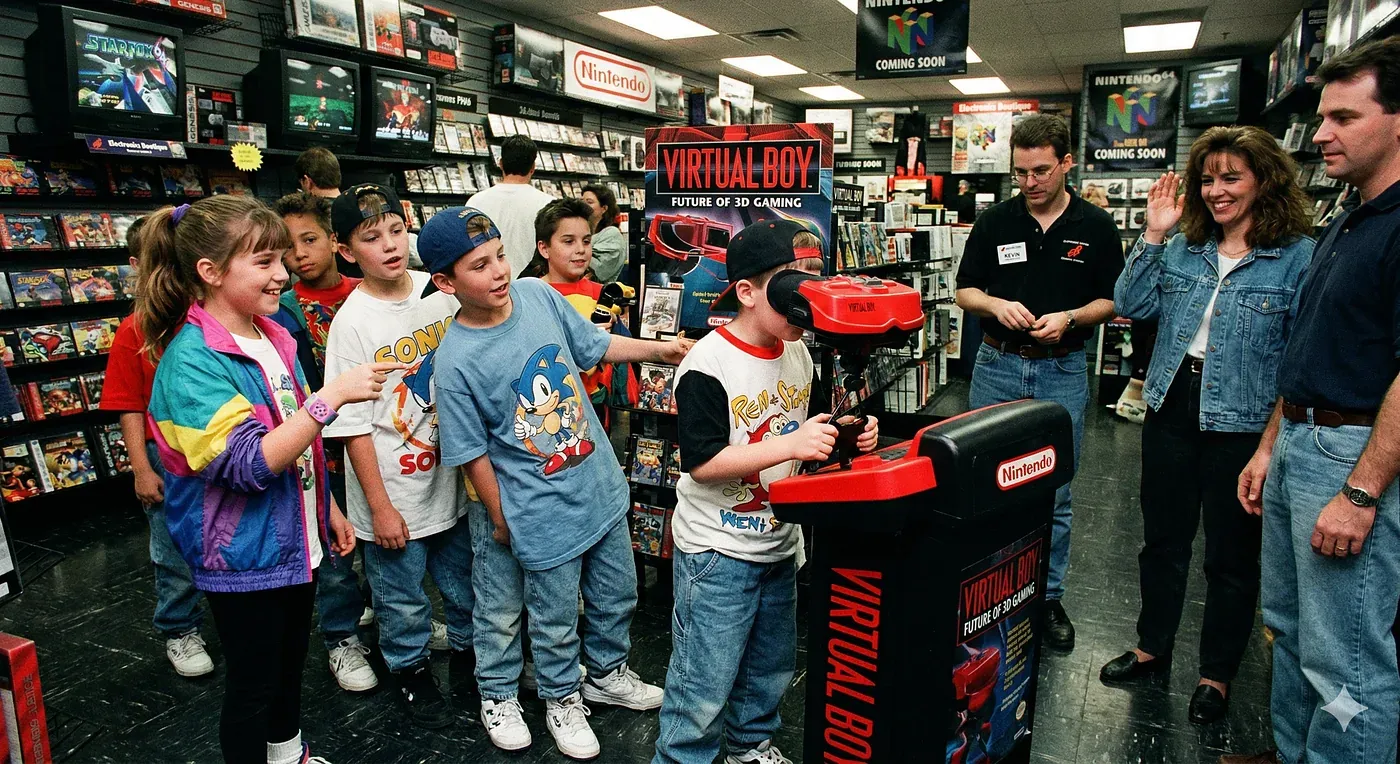
I was a Nintendo kid. Game Boy under the covers, Super Mario on weekends. The kind of child who memorized release dates the way other kids memorized soccer scores.
So when I saw the Virtual Boy on display at a department store in 1995, I just stopped. The red visor. The strange little legs it stood on. The word virtual on the box, next to Nintendo’s logo, which to me meant something close to a papal seal of approval.
I started saving my allowance that week.
By the time I had enough, it was already gone. Nintendo had killed it — quietly, without much ceremony — in less than a year. Twenty-two games total. Headaches. Weak sales. A software library that never really got started. [1]
I never got one. I’m probably better off.
But here’s the thing I keep coming back to: Meta just lost over $80 billion trying to do roughly the same thing. Better hardware, yes. Much more money, obviously. And still — dedicated headset, physical friction, a meaningful chunk of users getting nauseous, a social experience that never found its mass audience. [2]
Thirty years. That’s not bad luck. That’s a pattern.
Why “the tech just wasn’t ready” is the wrong explanation
The comfortable story about VR goes like this: brilliant idea, immature technology, and eventually the hardware catches up and everyone adopts it. The metaverse was supposed to be that moment — the crossing of the threshold.
I don’t think that’s what’s happening. And I don’t think it’s what has been happening since the nineties.
There’s a framework I find useful here. John A. List, an economist at the University of Chicago, wrote a book called The Voltage Effect (2022) about why ideas fail when they try to scale. His core observation is that scaling isn’t just about growth — it’s about whether something that works in a small, controlled setting can survive contact with the messiness of the real world. Most ideas experience what he calls a voltage drop: they lose power as they expand. And the reason is almost never that the idea was bad. It’s that some link in the chain wasn’t strong enough, and one weak link is all it takes. [3]
VR has been dropping voltage for three decades. The hardware got better. The weak links didn’t go away.
Three links that keep breaking
The first is replicability. VR demos are genuinely impressive. I’ve seen people gasp in headsets — the first-timer reaction is real. But that reaction depends on a very specific set of conditions: someone guiding the experience, a curated environment, a patient user who is giving the technology the benefit of the doubt.
Scale that to someone alone at home, battery dying, strap too tight, coffee table pushed against the wall — and you have a different product. Not a worse version of the demo. A different product. The demo experience was never replicable at scale, and nobody in the industry seemed to want to admit that.
The second is who was buying. Every generation of VR — from early arcade machines to the Rift to the Quest — found its traction with gamers, researchers, and enthusiasts. People who were already predisposed to tolerate friction, learn new interfaces, and evangelize niche hardware to their skeptical friends.
That’s not the mass market. List calls this the problem of unrepresentative early populations: your first users are almost never typical, and what works for them often doesn’t survive contact with everyone else. The VR industry kept reading enthusiasm in its core audience as a signal about the broader market. It wasn’t.
The third is cost — but not the cost you’re thinking about. The price of headsets has fallen. The real cost of VR is everything else: the time to set it up, the physical space it demands, the social cost of disappearing into a device that makes you completely unavailable to everyone around you. A phone is invisible. You can glance at it in a meeting, on the subway, while ostensibly listening to someone. VR requires surrender. Full removal from your environment. That’s a cost that doesn’t appear in any spec sheet, and it hasn’t compressed the way processor speeds have.
The two problems that engineering probably can’t fix
Here’s where it gets uncomfortable for VR optimists.
Most tech problems respond to engineering. Give it enough time and the screens get sharper, the batteries last longer, the price comes down. That’s roughly what happened with every mass-market computing platform we’ve ever seen.
VR has at least two problems that don’t work that way.
The first is biological. Motion sickness in VR — cybersickness, technically — is caused by a mismatch between what your visual system perceives and what your vestibular system feels. Your eyes think you’re moving. Your inner ear knows you’re not. Research puts the affected population somewhere between 20% and 95% depending on content type, which is an enormous range, but even the conservative end of that estimate is a serious adoption barrier. [4] Frame rate improvements help. Better tracking helps. But the underlying conflict is in human physiology, not in the hardware. You can push it down. You probably can’t push it to zero.
The second is social. Putting something on your face — something that covers your eyes, cuts you off from your environment, signals to everyone around you that you’ve left the room — is a fundamentally different kind of interaction than every other computing interface we’ve adopted at scale. The keyboard didn’t do that. The mouse didn’t do that. The smartphone really didn’t do that. VR does, and I’m not sure there’s an engineering solution to the social awkwardness of being a person wearing a visor in a shared space.
What Meta actually bet on
When Zuckerberg rebranded Facebook as Meta in October 2021 and announced the metaverse as the next frontier of computing, the underlying logic was something like: VR has been improving steadily, the hardware is finally good enough, and now the platform effects and network effects will take over.
What the bet missed was the distinction between improving and cleared. The hardware had improved, yes. But the weak links — the adoption friction, the representative audience problem, the biological constraint, the social cost — hadn’t been cleared. They’d been reduced, in some cases meaningfully. Not cleared.
Horizon Worlds, the flagship social experience Meta built for Quest headsets, never exceeded a few hundred thousand monthly active users. Not millions. Hundreds of thousands. Against a projection of a billion within a decade. [5] By early 2026, Meta was laying off Reality Labs staff, shutting down game studios, and moving the money to AI.
List’s framework, applied honestly before 2021, would have surfaced the right question: not “is the technology better?” but “have the weakest links actually been fixed?” They hadn’t been. And no amount of money was going to fix the ones that are rooted in human biology and social behavior rather than silicon.
Where this leaves us
VR isn’t dead. It works — genuinely well — in contexts where the friction is worth it. Surgical training, exposure therapy, military simulation, certain rehabilitation applications. [6] In those settings, the user population is motivated, the environment is controlled, and the value is high enough to justify the cost. That’s a real and defensible future for the technology.
What it isn’t, and what it has never managed to become in thirty years of trying, is infrastructure. The kind of platform that gets embedded in everyday life the way the phone did, the way the browser did — invisibly, frictionlessly, across wildly different contexts and users.
I think about that kid saving his allowance sometimes. The gap between how that technology was sold and what it actually was — not a fraud, exactly, but a demo that couldn’t survive the world outside the store.
The Quest 3 is a much better product than the Virtual Boy. But when I look at both of them, the distance between where VR is and where mass scale would require it to be looks, to me, roughly the same.
Notes
[1] The Virtual Boy launched in North America on August 14, 1995, priced at $179.95. It was discontinued in Japan in December 1995 and in North America in August 1996 — less than a year after launch — with only 22 games released and roughly 770,000 units sold worldwide. Sources: Wikipedia — Virtual Boy; NintendoWiki.
[2] Meta’s Reality Labs division accumulated over $83 billion in cumulative operating losses since 2020, with $19.2 billion lost in 2025 alone against $2.2 billion in revenue. Sources: TheStreet; TechCrunch.
[3] List, J. A. (2022). The Voltage Effect: How to Make Good Ideas Great and Great Ideas Scale. Currency/Crown.
[4] Research consistently finds cybersickness rates of 20–95% of users depending on content and movement type. The underlying mechanism — conflict between visual and vestibular/proprioceptive inputs — is a biological constraint that hardware improvements can reduce but have not eliminated. Sources: Frontiers in Human Neuroscience; ScienceDirect — sensory mismatch study; Stanney et al. (2020), Taylor & Francis.
[5] Horizon Worlds never exceeded a few hundred thousand monthly active users, against Zuckerberg’s projection of a billion users within a decade. By January 2026, Meta had cut approximately 1,500 Reality Labs employees and shut down three internal game studios. Sources: TheStreet; Design Rush.
[6] On VR’s validated clinical and training applications, see: Scientific Reports — Clinical predictors of cybersickness in VR.